SDS Section 4
(Tab "4.1 First aid") – details
Contents
I. Features of this section / tab
Entry areas (fields)
II. OSHA guidance
III. UN guidance
A4.3.4 SECTION 4: First-aid measures
A4.3.4.1 Description of necessary first-aid measures
A4.3.4.1.2 Provide advice whether:
A4.3.4.2 Most important symptoms/effects, acute and
delayed
A4.3.4.3 Indication of immediate medical attention and
special treatment needed, if necessary
IV. European Union guidance
SECTION 4: First aid measures
4.1 Description of first aid measures
4.1.2 Advice shall be provided as to whether:
4.2 Most important symptoms and effects, both acute
and delayed
4.3 Indication of any immediate medical attention and
special treatment needed
V. Health Canada guidance
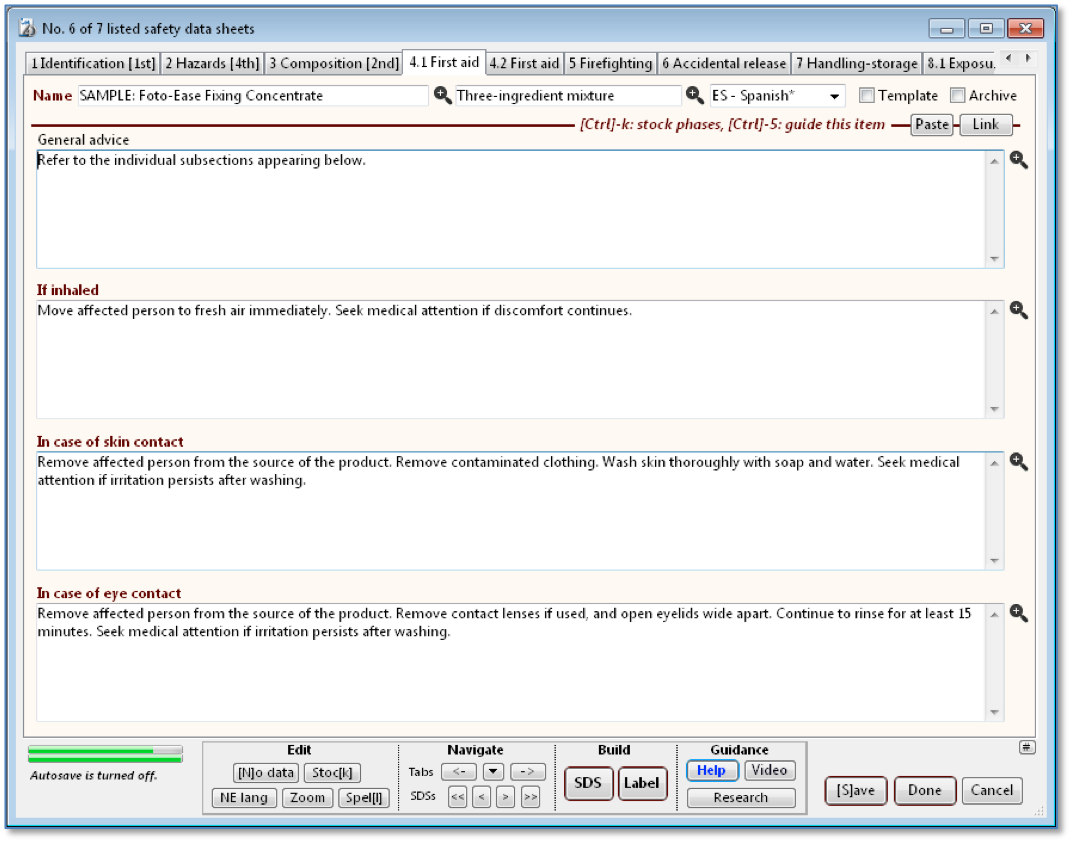
Tab “4.1 First Aid”
Refer to the
field descriptions in the Quick Start section, above.
NOTE:
The regulatory guidance that follows appears on both First aid tabs (“4.1 First aid” and “4.2
First aid”).
From: “OSHA Brief: Hazard
Communication Standard: Safety Data Sheets”, https://www.osha.gov/Publications/OSHA3514.html.
This section describes the initial
care that should be given by untrained responders to an individual who has been
exposed to the chemical. The required information consists of:
·
Necessary first-aid instructions by relevant
routes of exposure (inhalation, skin and eye contact, and ingestion).
·
Description of the most important symptoms or
effects, and any symptoms that are acute or delayed.
·
Recommendations for immediate medical care and
special treatment needed, when necessary.
From: United Nations (2017). Globally
Harmonized System of Classification and Labelling of Chemicals (GHS), Seventh
Revised Edition. https://unece.org/ghs-rev7-2017.
United Nations. Reprinted with permission.
This section describes the initial care that can be given
by an untrained responder without the use of sophisticated equipment and
without a wide selection of medications available. If medical attention is
required, the instructions should state this, including its urgency. It may be
useful to provide information on the immediate effects, by route of exposure,
and indicate the immediate treatment, followed by possible delayed effects with
specific medical surveillance required.
A4.3.4.1.1 Provide first-aid instructions by relevant
routes of exposure. Use sub-headings to indicate the procedure for each route (e.g. inhalation, skin, eye and ingestion). Describe expected
immediate and delayed symptoms.
(a) immediate medical attention is required and if delayed effects can
be expected after exposure;
(b) movement of the exposed individual from the area to fresh air is
recommended;
(c) removal and handling of clothing and shoes from the individual is
recommended; and
(d) personal protective equipment (PPE) for first-aid responders is
recommended.
Provide information on the most important
symptoms/effects, acute and delayed, from exposure.
Where appropriate, provide information on clinical
testing and medical monitoring for delayed effects, specific details on
antidotes (where they are known) and contraindications.
From: "COMMISSION
REGULATION (EU) 2020/878 of 18 June 2020, amending Annex II to Regulation (EC)
No 1907/2006 of the European Parliament and of the Council concerning the
Registration, Evaluation, Authorisation and Restriction
of Chemicals (REACH)”. Official Journal of the European Union, 26.6.2020.
This section of the safety data sheet shall describe the
initial care in such a way that an untrained responder can understand and provide
it without the use of sophisticated equipment and without the availability of a
wide selection of medications. If medical attention is required, the
instructions shall state this, including its urgency.
4.1.1 First aid instructions shall be provided by
relevant routes of exposure. Subdivisions shall be used to indicate the
procedure for each route, such as inhalation, skin, eye and ingestion.
(a) immediate medical attention is required and if delayed effects can
be expected after exposure;
(b) movement of the exposed individual from the area to fresh air is
recommended;
(c) removal and handling of clothing and shoes from the individual is
recommended; and
(d) personal protective equipment for first aid responders is
recommended.
Briefly summarised information
shall be provided on the most important symptoms and effects, both acute and
delayed, from exposure.
Where appropriate, information shall be provided on
clinical testing and medical monitoring for delayed effects, specific details
on antidotes (where they are known) and contraindications.
For some substances or mixtures, it may be important to
emphasize that special means to provide specific and immediate treatment shall
be available at the workplace.
From: "Technical
Guidance on the Requirements of the Hazardous Products Act and the Hazardous
Products Regulations, WHMIS 2015 Supplier Requirements", Cat.: H129-64/1-2016E-PDF. December
2016. ©2016, Her Majesty the Queen in Right of Canada, as represented by the
Minister of Health.
This section describes the initial
care that should be given to an individual who has been exposed to the product.
The required information consists
of:
·
A description of necessary first aid measures,
subdivided according to the different routes of exposure, i.e., inhalation,
skin and eye contact, and ingestion
·
A description of the most important symptoms and
effects, whether acute or delayed
·
An indication for immediate medical attention
and special treatment needed, if necessary
[rev. 4.8.2021]